Is Sunscreen Safe for Kids? A Complete Guide to Chemical vs. Mineral Sunscreen
If you’ve spent any time researching sunscreen for your kids, you’ve probably noticed something, the internet is full of conflicting opinions. Some sources say sunscreen is essential every single day. Others warn about toxic ingredients and tell you to avoid it entirely.
No wonder parents feel confused.
The truth is that sun protection doesn’t have to be complicated or fear-based. As a naturopathic doctor and mom, my approach focuses on balance. Parents can respect the incredible benefits of sunlight while also protecting children from burns and long-term skin damage.
So let’s walk through the science, the ingredients, and the practical choices that help you answer the big question many parents are asking:
Is sunscreen safe for kids?
The short answer is yes, when you choose the right kind and use it thoughtfully.

Affiliate Disclaimer: Some of the links in this article are affiliate links, which means we may earn a commission if you make a purchase through those links at no additional cost to you. We only recommend products that we believe in and have personally used or thoroughly researched. Your support helps us continue to provide valuable content.
Understanding Sunscreen Safety: What Parents Need to Know
Sunlight is essential for human health. It helps regulate circadian rhythms, supports mood, and allows the body to produce vitamin D, which plays an important role in immune health, bone strength, and inflammation regulation.
But sunlight also contains ultraviolet (UV) radiation, which in excessive amounts can damage skin cells and lead to burns. Repeated burns in childhood are associated with an increased risk of skin cancer later in life.
That’s why sun protection matters, especially for kids whose skin can be more sensitive.
However, the type of sunscreen used matters just as much as using sunscreen itself. Many conventional sunscreens rely on chemical filters that are absorbed into the bloodstream. This has raised questions among parents about long-term safety.
Fortunately, there are safer alternatives.
For families who want effective protection with minimal concerns, mineral sunscreens are generally the preferred option for children.
Chemical vs. Mineral Sunscreen: Which Is Better for Kids?
Sunscreens work by either absorbing UV rays or physically blocking them. These two mechanisms correspond to chemical and mineral sunscreens.
Here’s a quick comparison:
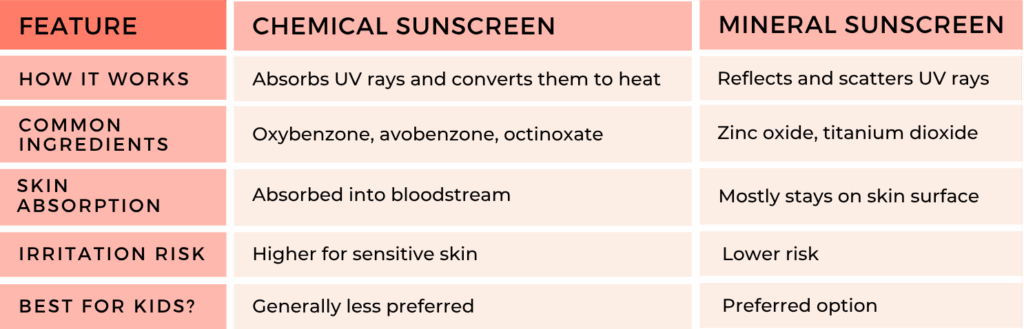
Mineral sunscreens, especially those made with non-nano zinc oxide, are typically recommended by integrative and pediatric dermatology communities for children because they:
- Sit on top of the skin rather than being absorbed
- Are less likely to irritate sensitive skin
- Provide broad-spectrum UVA and UVB protection
They may leave a slight white tint, but many newer formulations blend much better than older versions.
Sunscreen Ingredients to Avoid (and Why)
When choosing the best sunscreen for kids, ingredient awareness can make a big difference.
Some commonly used chemical sunscreen ingredients have raised safety questions due to hormone disruption concerns, skin irritation, or environmental impact.
Ingredients many parents choose to avoid include:
- Oxybenzone – Research has suggested potential hormone-disrupting effects, and it is one of the ingredients most commonly detected in blood testing after sunscreen use.
- Octinoxate – Another chemical UV filter linked to hormone concerns and banned in some regions due to coral reef damage.
- Homosalate – Concerns about hormone activity have led some regulatory bodies to restrict its use.
- Octocrylene – Can degrade into benzophenone, a compound associated with potential toxicity.
For families trying to minimize chemical exposure, mineral-based sunscreens with zinc oxide are generally the simplest and safest choice.
When to Use Sunscreen on Your Child
One of the biggest misconceptions is that sunscreen should be used all day, every day, regardless of sun exposure.
In reality, sunscreen is most useful when the risk of burning increases.
Situations where sunscreen is helpful include:
- Beach days
- Swimming
- Long outdoor play
- Hiking or sports in midday sun
- Vacations in sunny climates
- Children with fair or burn-prone skin
If you expect your child to be in the sun longer than 20–30 minutes, especially during peak UV hours (10 AM – 4 PM), sunscreen or sun-protective clothing becomes a good idea.
For infants under 6 months, pediatric guidance generally favors shade and protective clothing rather than sunscreen whenever possible.
Remember: sunscreen works best when applied 15–20 minutes before sun exposure and reapplied every two hours, or sooner if swimming or sweating.
When You DON’T Need Sunscreen (Yes, Really)
Here’s the part that surprises many parents.
There are actually times when skipping sunscreen is beneficial.
Short periods of direct sun exposure help the body naturally produce vitamin D. Many health experts suggest that 10–20 minutes of sun exposure on uncovered skin can support healthy vitamin D levels, depending on skin tone, location, and time of year.
So if you and your kids are simply outside for a short walk or quick playtime, sunscreen often isn’t necessary.
As I often tell parents:
If you’re only out in the sun for about 15–20 minutes, it’s perfectly reasonable to skip the sunscreen and soak up some natural vitamin D.
Of course, everyone’s skin is different. Some children burn more quickly than others, so it’s important to pay attention to your child’s individual tolerance.
And remember, sunburn is what we want to avoid, not sunlight itself.

Doctor Mom Approved: Best Safe Sunscreen Brands for Kids
If you decide to use sunscreen, choosing a high-quality product can make a big difference.
When I recommend sunscreens to families, I look for products that:
- Use non-nano zinc oxide
- Avoid synthetic fragrances
- Skip hormone-disrupting ingredients
- Work well for sensitive skin
- Are practical for everyday parenting
Recommended safe sunscreen options for kids include:
- Badger Sunscreen – A classic mineral sunscreen made with simple, organic ingredients. Great for the whole family.
- Kinfield – Lightweight and easy to apply, especially nice for the face and body without the heavy feel some mineral sunscreens have.
- Earth Mama Mineral Sunscreen – Formulated specifically for babies and sensitive skin.
- Waxhead Sunscreen – Excellent for active kids who spend a lot of time outdoors.
- Sky & Sol Sunscreen – A newer brand I’ve recently started using and really love. The ingredient list is incredibly clean and it works beautifully on both face and body.
If you want to try Sky & Sol, you can use code DRELANA for 10% off.

How I Protect My Own Kids: A Real-Life Approach
Parents often ask what I actually do with my own kids when it comes to sun exposure.
Here’s the honest answer: I aim for balance, not perfection.
If we’re heading outside for a short time, say a walk around the neighborhood or playing in the yard for 15–20 minutes, I skip sunscreen entirely and let them enjoy the sunshine.
If we’re going to be outside longer, I prioritize sun-protective clothing first.
That means:
- Rash guards at the beach
- Wide-brimmed hats
- Lightweight long sleeves
- UV-protective swimwear
Clothing is one of the most effective and lowest-toxin sun protection strategies available.
For exposed areas like the face, shoulders, or legs during longer outings, I’ll apply a mineral sunscreen.
This layered approach (sun exposure, clothing protection, and targeted sunscreen) helps protect skin while still respecting the health benefits of sunlight.
And perhaps most importantly, it keeps sun protection simple and sustainable for real life.
Common Sunscreen Questions Answered
IS SUNSCREEN SAFE FOR KIDS?
Yes. Sunscreen is considered safe when used appropriately. Mineral sunscreens containing zinc oxide are generally the preferred option for children.
WHAT IS THE BEST SUNSCREEN FOR KIDS?
The best options are mineral-based sunscreens with non-nano zinc oxide and minimal additives. Brands like Badger, Earth Mama, Waxhead, Kinfield, and Sky & Sol are popular among families.
DO KEEDS NEED SUNSCREEN EVERYDAY
Not necessarily. Short sun exposure of 10–20 minutes can support vitamin D production. Sunscreen becomes more important when children will be outside long enough to risk burning.
IS MINERAL SUNSCREEN BETTER THAN CHEMICAL SUNSCREEN FOR KIDS
Mineral sunscreens are often preferred because they sit on the skin’s surface rather than being absorbed into the bloodstream.
WHAT’S THE SAFEST WAY TO PROTECT KIDS FROM THE SUN?
The best strategy combines several approaches: sensible sun exposure, protective clothing, shade, and mineral sunscreen when needed.
So...What's The Best Option For Sun Protection for Kids?
Sunlight is not the enemy, it’s a powerful part of human health.
The goal isn’t to eliminate sun exposure, but to avoid sunburn while allowing children to benefit from time outdoors.
When needed, choosing a clean mineral sunscreen can provide an extra layer of protection without unnecessary chemical exposure.
So take a deep breath, mamas. The sun doesn’t have to be something to fear.
With a thoughtful approach including short sun exposure, protective clothing, and safe sunscreen options, you can help your kids enjoy the sunshine safely.
And honestly, that’s what childhood should be full of: fresh air, sunshine, and lots of outdoor play.
Looking for More Resources? We've Got You Covered!